Welcome
Integrated Metadata Management
One integrated model. Multiple use cases. A smarter way to build, manage, and evolve digital services.
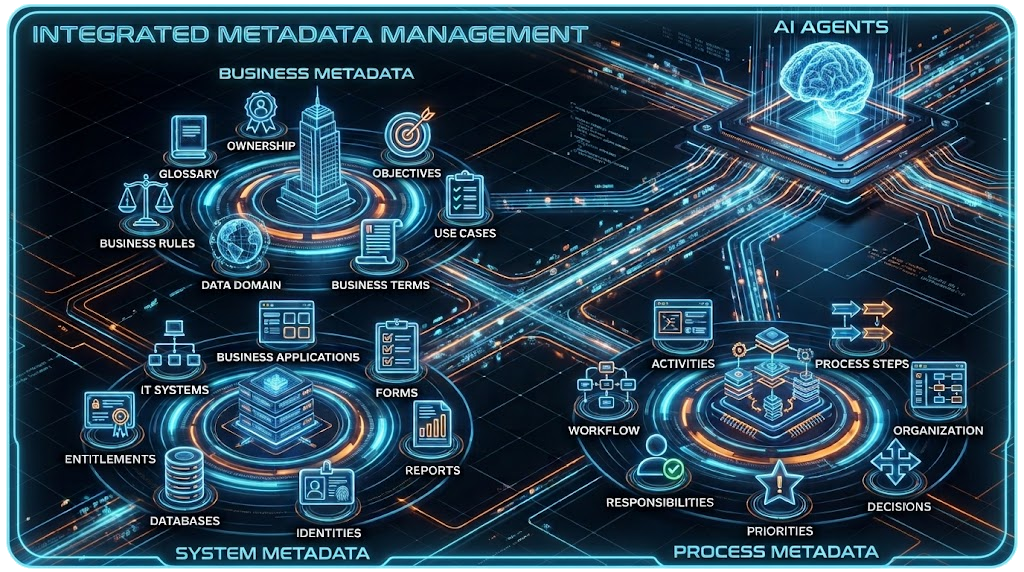
Welcome to an integrated metadata management platform that connects business knowledge, business terminology, operational processes, technical architecture, and AI agent definitions in a unified environment.
The platform demonstrates how structured metadata, governed business definitions, and interconnected models provide a consistent foundation for understanding, designing, testing, operating, and continuously improving services and applications.
By bringing information together across business and technology domains, the platform helps establish a shared understanding of what an organization means, how it operates, how its systems interact, and how intelligent agents can support its activities.
Explore how integrated metadata transforms disconnected information into actionable knowledge and connected models.
One Integrated Approach
Traditional approaches often manage business terminology, business processes, technical components, service information, and AI agent definitions separately. This can lead to fragmented knowledge, duplicated definitions, inconsistent terminology, limited traceability, and additional effort when business requirements or systems change.
Integrated metadata management offers a different approach: connect these elements through a common model that makes their meanings, ownership, relationships, and dependencies visible, reusable, and easier to maintain.
The result is a shared foundation where business concepts are connected to the processes, data, applications, services, and intelligent capabilities that depend on them.
Integrated Metadata Domains
Business Terms, Definitions, and Use Cases
Create and maintain a governed business glossary that captures the terminology used across the organization.
Each business term can have a standardized definition, business context, accountable owner, responsible steward, synonyms, classification, status, and relationships to other terms and metadata assets.
For example, a term such as Customer, Active Contract, Business Capability, or Service Availability can be defined consistently and linked to the business rules, data entities, processes, reports, applications, and AI agents that use it.
This enables organizations to:
- Establish a shared vocabulary across business and technology teams.
- Reduce ambiguity, duplication, and conflicting definitions.
- Clarify ownership and accountability for business concepts.
- Connect business terminology to data models, processes, applications, and services.
- Identify where a term is used and assess the impact of changing its definition.
- Support data governance, regulatory traceability, reporting consistency, and AI grounding.
- Business terms become connected metadata assets rather than isolated entries in a glossary.
Business Metadata Management
Describe and govern the business context, including business concepts, terms, definitions, capabilities, organizational structures, business rules, roles, responsibilities, objectives, policies, and performance indicators.
Business metadata establishes the meaning, purpose, and context behind processes, services, data, systems, and decisions.
It provides a common business vocabulary that helps teams interpret information consistently across departments and applications.
Process Metadata Management
Define how work gets done through business processes, activities, workflows, events, decisions, inputs, outputs, business rules, and dependencies.
Process metadata connects business intentions and terminology with the operational activities and technical capabilities that support them.
It helps teams understand how business concepts are applied in practice, how work flows across organizational boundaries, and where automation or improvement opportunities exist.
Technical Metadata Management
Describe the technical landscape, including applications, services, APIs, data structures, integrations, components, interfaces, databases, and system dependencies.
Technical metadata connects business definitions and requirements with the systems and data structures that implement and support them.
It also helps maintain traceability between business terminology, logical and physical data models, service interfaces, and technical implementations.
AI Agent Metadata Management
Define the knowledge, capabilities, instructions, tools, responsibilities, permissions, and relationships that enable AI agents to perform specific tasks.
Agent metadata provides a structured foundation for designing, configuring, evaluating, and maintaining intelligent agents aligned with business terminology, organizational policies, processes, and technical services.
By connecting agents to governed business definitions and relevant models, the platform can help reduce ambiguity, improve consistency, and make agent behavior easier to understand and evaluate.
Models as the Foundation
At the center of the platform is a connected set of models that brings together business, process, technical, and AI agent metadata.
Rather than treating business glossaries, documentation, definitions, and technical models as isolated assets, the platform demonstrates how they can serve as shared, reusable sources of information across the application lifecycle.
Models establish relationships between:
- Business objectives, capabilities, concepts, and terminology.
- Business terms, definitions, policies, and rules.
- Process steps, activities, decisions, and operational responsibilities.
- Applications, service interfaces, data entities, and integrations.
- AI agent capabilities, tools, instructions, and knowledge sources.
For example, a business term can be linked to its definition, the business rule governing it, the process in which it is applied, the data entity representing it, the API exposing it, and the AI agent using it.
This integrated foundation supports consistency, traceability, governance, impact analysis, and the evolution of models as business needs and technical environments change.
Define once. Govern centrally. Connect across domains. Reuse wherever value is created.
From Models to Practical Use Cases
Integrated metadata becomes more valuable when it supports real activities across the business, development, and operational lifecycle.
- Business Glossary and Metadata Governance
- Create, organize, classify, review, approve, and maintain business terms and definitions.
- Establish ownership, stewardship, business context, and relationships between terms and other metadata assets. Identify duplicate concepts, resolve conflicting definitions, and maintain a consistent vocabulary across departments.
- Model Creation and Maintenance
- Create, organize, connect, and maintain models across business, process, technical, and agent domains.
- Establish a consistent representation of the organizational environment and evolve it as business requirements, terminology, systems, and services change.
- Testing and Quality Assurance
- Use connected models to identify dependencies, derive test scenarios, map business definitions and requirements to expected behavior, and maintain test assets as processes and systems evolve.
- Business terms and rules can provide context for validating data, testing business decisions, and checking consistency across applications.
- Service Management and Support
- Connect service definitions, business terminology, technical components, operational processes, dependencies, and support knowledge.
- Help teams understand service context, investigate issues, identify relevant information, and communicate consistently about business and technical incidents.
- AI Agent Design and Configuration
- Use structured models as a foundation for defining agent responsibilities, capabilities, tools, instructions, permissions, and access to relevant business and technical knowledge.
- Connect agents to approved business definitions, rules, and policies so that they can interpret business concepts more consistently and operate within an explicit organizational context.
- Intelligent Automation
- Identify opportunities to automate activities, coordinate workflows, and connect AI agents with the processes, business rules, and services they support.
- Use metadata relationships to understand which activities can be automated, what information is required, and which business constraints must be respected.
- Impact Analysis and Change Management
- Understand how changes to business terms, definitions, rules, process activities, applications, interfaces, or agent capabilities may affect connected models and downstream use cases.
- For example, changing the definition of Active Customer can trigger an impact assessment across customer data models, eligibility rules, reporting logic, APIs, test cases, and AI agents that use the concept.
- Data Governance and Business Traceability
- Connect business definitions to logical and physical data structures, data products, reports, applications, and operational processes.
- Support the identification of data ownership, the clarification of business meaning, and the assessment of how data is created, transformed, consumed, and interpreted across the organization.
Connecting Knowledge, Processes, Systems, and Intelligence
The platform brings together five complementary perspectives:
- Understand the business through shared concepts, terminology, definitions, objectives, rules, and capabilities.
- Govern business knowledge through ownership, stewardship, classification, approval, and lifecycle management.
- Understand the work through processes, activities, decisions, and operational dependencies.
- Understand the technology through applications, services, interfaces, data structures, and system relationships.
- Enable intelligent action through well-defined AI agent capabilities connected to relevant business knowledge, models, and workflows.
Together, these perspectives create a foundation for managing complexity while maintaining a coherent view of how an organization defines, governs, and operates its business.
The result is an integrated environment in which metadata and models can support people, applications, services, testing activities, governance processes, and AI-powered solutions.
Explore the Platform
Discover how integrated metadata management connects business terminology, definitions, models, processes, systems, and AI agents through a shared modeling approach.
Explore the available capabilities, examine relationships between metadata elements, and see how business terms can be defined, governed, connected, and reused across multiple use cases.
Whether the objective is to establish a business glossary, improve service support, strengthen testing, enhance data governance, maintain technical knowledge, or create smarter AI agents, the starting point is the same: a connected, structured, governed, and maintainable model of the environment.
One connected foundation for business knowledge, metadata, models, services, processes, and intelligent agents.
Note: This platform is a demonstration of the integrated metadata management concept. Available features and supported workflows depend on the current implementation.